My aunt’s house operates on a principle of accumulation: each verse adds an element to a chain that the child must recall from memory, from beginning to end. This mechanism distinguishes it from nursery rhymes with a fixed refrain and makes it a tool for working on sequential memory, diction, and verbal anticipation. The challenge remains to understand how to exploit this structure beyond simple repetition.
Cumulative structure of the nursery rhyme: what each verse mobilizes
The song begins with a unique element (the house) and then successively stacks the path, the garden, the apple tree, the apple, the bird, and the feather. Each new verse repeats the entire previous chain before appending an additional word.
This format produces a progressive increase in the memorization load. In the first verse, the child retains a single proposition. By the sixth, they must recall a sentence containing seven elements linked in the exact order.
| Verse | New element | Total number of elements to recall |
|---|---|---|
| 1 | House | 1 |
| 2 | Path | 2 |
| 3 | Garden | 3 |
| 4 | Apple tree | 4 |
| 5 | Apple | 5 |
| 6 | Bird | 6 |
| 7 | Feather | 7 |
The difficulty does not come from the melody, which is very simple, but from the syntactic chaining: “the feather of the bird of the apple of the apple tree of the garden of the path of the house of my aunt.” Diction becomes the real challenge starting from the fourth verse.
The lyrics of my aunt’s house exist in several regional variants: some replace the path with a large courtyard or add elements to the garden. The cumulative structure remains identical in all cases.
Inclusive session for a child: adapting the nursery rhyme according to age and abilities
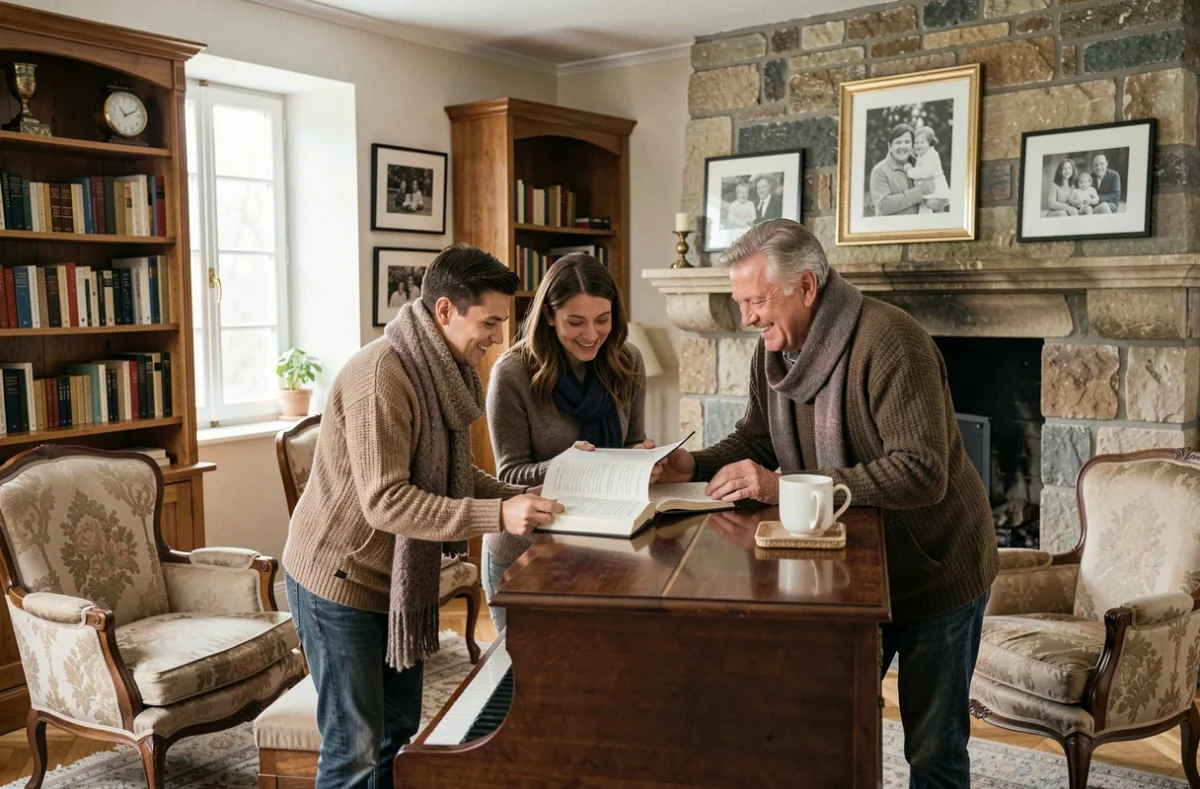
Transforming this song into an inclusive session first requires keeping the pitch at a comfortable height for the child, without pushing towards high or low notes. The goal is regular practice, not vocal performance.
Pedagogical progression in four steps
A structured sequence allows going beyond simple looping listening:
- Presentation of the song: the adult sings alone for the first time, articulating slowly, while the child listens without pressure to participate
- Repetition and memorization: going verse by verse, the child reproduces each segment before moving on to the next
- Expressive interpretation: the child adds gestures, miming, or variations in volume to take ownership of the text
- Autonomous recall: the child sings alone, with or without visual support of the lyrics
This progression works well both in class and at home. It adapts to children who need more time in the memorization phase: simply staying on the first three verses before adding the rest is sufficient.
Technique of the blank before the end of the sentence
The adult sings the beginning of a segment, then stops just before the last word. The child completes it. This process works on anticipation and avoids mechanical line-by-line repetition.
For example: “It was the apple tree of the garden of the path of the house of my…” and the child finishes with “aunt.” The blank stimulates active memory rather than passive imitation.
Managing errors without interruption
In case of a forgotten or mispronounced word, it is preferable to repeat the sentence correctly while continuing the game, without marking the error. Direct corrections can discourage young children and break the dynamic of the song.
Singing together or listening to a screen: what changes with the presence of an adult
The lyric pages and online videos make it easy to find the text. However, they do not replicate the exchange created by shared singing between an adult and a child.
Singing together involves eye contact, real-time rhythm adjustment, and the possibility of associating gestures with words. A child who mimics the apple tree with their arms or pretends to hold a feather engages their body in memorization, which an audio track alone does not allow.
This dimension is particularly relevant for my aunt’s house, where the increasing length of the sentences requires support. A four-year-old who loses track by the fifth verse needs an encouraging glance or a gesture to prompt them, not a “replay” button.
Variants of the song: adapting the text to renew the exercise
The most common version follows the path of house, path, garden, apple tree, apple, bird, feather. A documented variant, “In my aunt’s garden,” modifies the accumulated elements while maintaining the same principle.
Each variant renews the memory exercise without the child needing to learn a new melody.
- Classic version: house, path, garden, apple tree, apple, bird, feather
- Personalized version: the adult invents new elements with the child to extend the song beyond the usual verses
Personalization works well in family or group settings. Allowing a child to suggest the next element of the chain (“On this feather, what was there?”) transforms the nursery rhyme into an exercise of imagination while maintaining the accumulation structure.
My aunt’s house remains one of the few French nursery rhymes where the difficulty increases in a linear and measurable way, verse by verse. It is this mechanism that makes it a resource usable well beyond the first listen, provided it is accompanied rather than simply played.