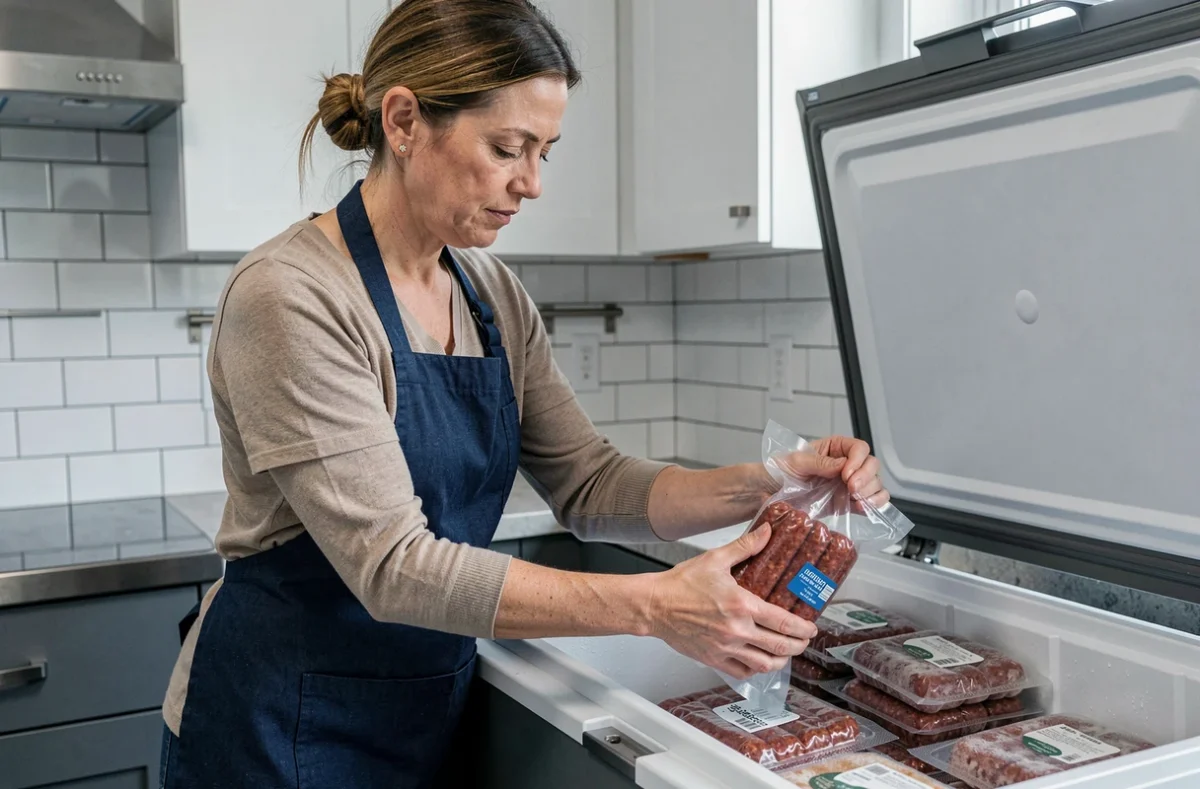
The merguez, a sausage made from minced lamb or beef that is heavily spiced, has a lipid profile and water content that directly affect its freezing stability. Storing merguez in the freezer for a long duration does not pose a strict health risk as long as the cold chain remains intact, but the organoleptic quality deteriorates according to specific mechanisms that must be understood.
Lipid oxidation and freezer burn on the merguez
The merguez contains a significant proportion of fat. During prolonged freezing, these lipids undergo accelerated oxidation due to inadequate packaging. This phenomenon manifests as a noticeable rancidity detectable by smell upon thawing, even before cooking.
Freezer burn, those whitish and dried-out areas on the surface, results from the sublimation of water contained in the meat. On a merguez, the natural casing or reconstituted collagen does not provide a sufficient barrier against this phenomenon. A simple plastic wrap allows enough air to pass through for degradation to set in within a few weeks.
We recommend vacuum packaging or, if not possible, double wrapping: plastic wrap in direct contact followed by a freezer bag with maximum air expulsion. This precaution significantly delays the onset of freezer burn and limits fat oxidation.
The freezing duration of merguez thus depends as much on the quality of the packaging as on the temperature itself.
Freezer temperature and actual shelf life of merguez
Below -18 °C, no pathogenic microorganisms develop. Freezing does not sterilize the meat; it suspends microbial activity. A properly frozen merguez before its use-by date remains technically safe from a health perspective as long as the temperature has never risen.
The nuance lies in quality. Beyond two to three months, texture and flavor gradually degrade. The characteristic spices of the merguez (chili, cumin, coriander) lose their aromatic intensity. The volatile compounds responsible for flavor evaporate even at very low temperatures, albeit slowly.
Impact of temperature variations
A domestic freezer does not maintain a perfectly stable temperature. Each door opening causes a slight thermal rise. Over a repeated daily cycle for months, these micro-fluctuations accelerate the formation of larger ice crystals inside the meat.
These crystals puncture muscle cells. Upon thawing, the merguez releases more juice, resulting in a drier texture after cooking. A chest freezer, opened less frequently, better preserves quality than a freezer integrated into a refrigerator.
Thawing merguez: mistakes that create real risks
Food safety is not at stake during freezing but during thawing. ANSES explicitly recommends avoiding thawing at room temperature. The surface of the merguez quickly reaches a temperature range favorable to bacterial multiplication while the center remains frozen.
Reliable methods:
- In the refrigerator, between 0 °C and 4 °C, for several hours. The merguez thaws slowly and remains in a safe temperature zone from start to finish of the process.
- In the microwave on defrost mode, with immediate cooking afterward. The rapid passage through the critical zone requires not letting the meat rest before cooking.
- Direct cooking from the frozen state, over moderate heat. The merguez can handle this method as long as the cooking time is extended to ensure sufficient internal temperature.
A thawed merguez should not be refrozen raw. However, after complete cooking and rapid cooling, refreezing remains possible without notable health risks.
Freezing raw or cooked merguez: what impact on preservation
The choice to freeze before or after cooking alters the suitable shelf life. A raw frozen merguez retains better flavor potential in the first weeks, as cooking fixes the spice aromas and Maillard reactions occur only once.
Freezing a cooked merguez has a practical advantage but a sensory drawback: reheating tends to dry out the product further. The water content, already reduced by the first cooking, decreases again during freezing and then reheating.
Product condition before freezing
The freezing date matters as much as the duration spent in the freezer. Freezing a merguez on the day of purchase preserves the initial microbial load at its lowest level. A merguez stored for three days in the refrigerator before freezing starts with a heavier bacterial history, even though freezing then halts any proliferation.
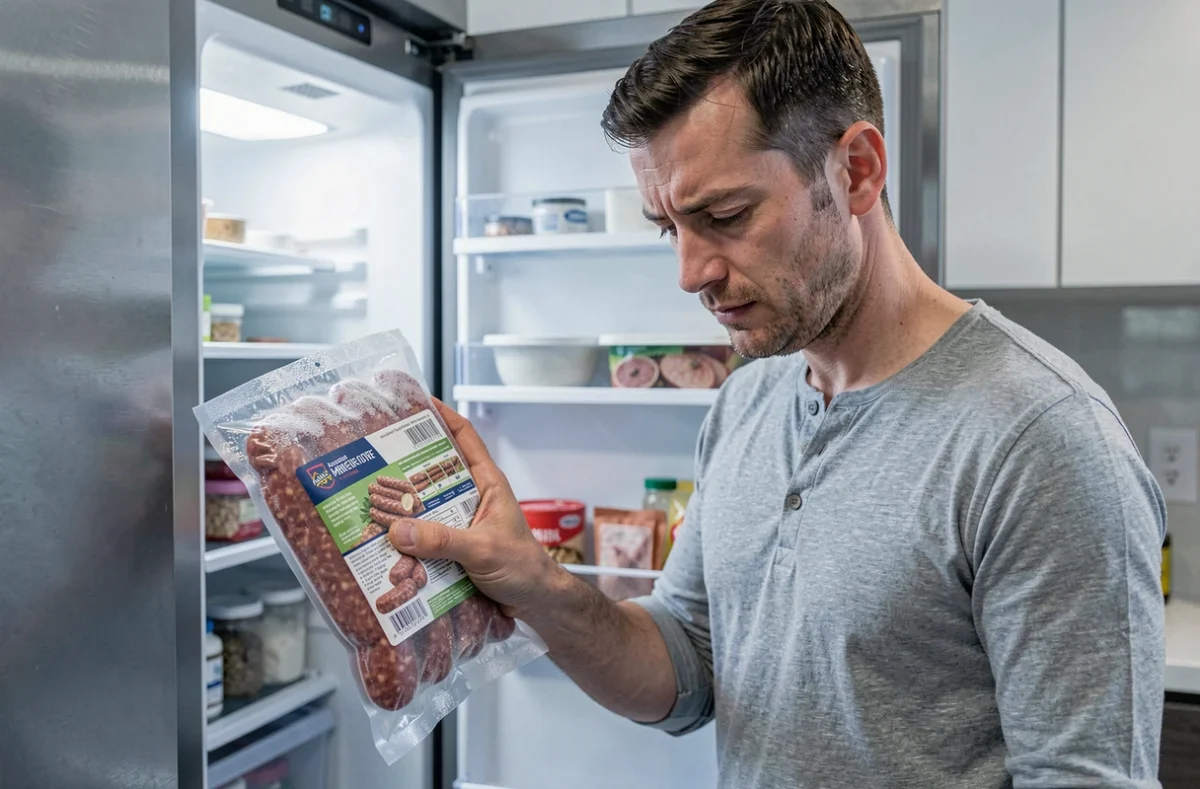
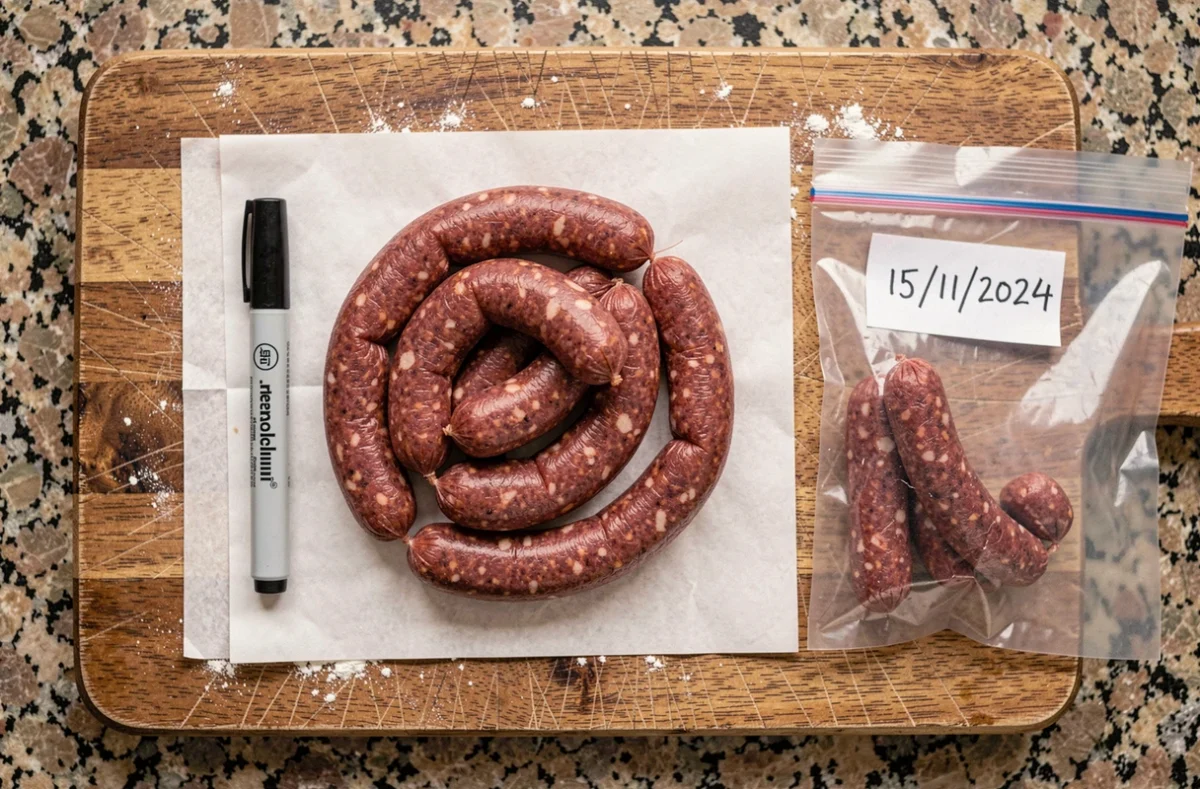
We regularly observe that labeling freezer bags remains a weak point. Noting the freezing date and the nature of the product (raw or cooked) on the bag allows for a first-in, first-out rotation, which limits prolonged forgetfulness.
Recognizing a degraded frozen merguez before cooking
Some visible signs upon opening the bag indicate advanced degradation:
- Extensive presence of opaque frost and large ice crystals on the entire surface, a sign of repeated sublimation and recrystallization.
- Marked discoloration, with grayish or brownish areas replacing the characteristic red hue of the spices.
- Rancid or sour smell upon thawing, even before any cooking, indicating advanced lipid oxidation.
- Sticky or slimy texture to the touch after complete thawing in the refrigerator.
None of these signs necessarily indicate a bacterial danger if the cold chain has been maintained. They reflect a loss of sensory quality that is often prohibitive. A merguez without a suspicious odor after thawing in the refrigerator remains consumable, even after several months, provided it is cooked thoroughly.
Long-term storage in the freezer works for merguez just as it does for any spiced minced meat: food safety relies on the rigor of the cold chain and thawing, not on an arbitrary date marked on a calendar. The limiting factor remains quality, which degrades well before any health risk appears.