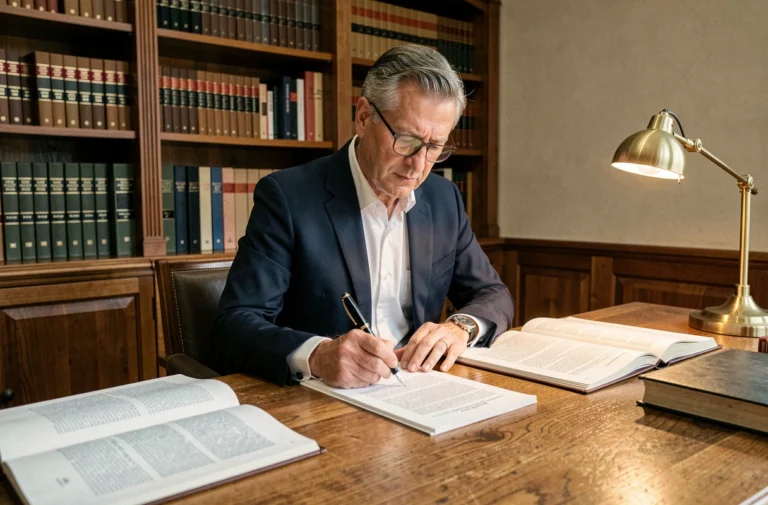
In the complex universe of legal structures, notaries occupy a strategic position. Legal professionals, notaries play an essential role in drafting legal documents, managing real estate, and regulating inheritances. Their profession, governed by strict standards, requires not only a deep knowledge of the law but also meticulous internal organization to ensure the legal security of the documents. This insight into the organization of notarial offices reveals the behind-the-scenes of a profession that combines tradition and modernity, where confidentiality, rigor, and expertise are the key words.
The role and functions of notaries in the French legal system
Within the French legal system, the notary is the public officer entrusted with a public service mission. Their main function lies in the drafting and recording of notarial acts, granting these documents probative and enforceable force. The notarial act, a legal document recorded by a notary, serves as a guarantee of legal security for the parties involved. By certifying the truth of the facts and commitments recorded therein, the notary assumes a crucial responsibility in preserving individual and collective rights.
The activities of a notarial office extend beyond mere document drafting. In the context of a real estate transaction, for example, the notary plays a central role, intervening from the pre-contractual phase to the final conclusion of the sale. The parties, buyer and seller, then meet at the office to formalize the transfer of ownership, under the supervision and with the assistance of the notary. The notary ensures the transparency of the operation, the accuracy of financial transfers, and the regularity of titles.
In family matters, the constitution of a dowry is one of the many prerogatives of the notary, who advises and supports families in setting up wealth management arrangements. The parents of the future groom, often accompanied by their notarial advisor, engage in a formal and secure framework, thus preparing the couple’s future under the best conditions.
The professional advice provided by notaries proves fundamental, both in the business field and in the personal management of assets. Figures such as Jacques Michaelis, who records notarial acts and manages lands, or Pierre de Oxnago, community notary, illustrate the diversity and complexity of notarial missions. These professionals, at the heart of the legal organization, weave daily the links between law, citizens, and institutions, thereby making notary work inseparable from French legal life.

The different legal structures for practicing the notarial profession
In the episcopal city of Cavaillon, as in the rest of France, notaries can choose different legal structures for practicing their profession. The traditional archetype is the individual notarial office, where a single notary, like a craftsman, offers their services to the community. This form of practice, often inherited and passed down through generations, remains prevalent in the local social and legal fabric.
With the evolution of needs and regulations, notaries are increasingly turning to more collaborative structures. The professional civil society (SCP) allows several notaries to share the material and human resources necessary for their activity while maintaining their legal independence. This form of society promotes a pooling of skills and a specialization of areas of intervention, ranging from the registration of acts to more complex operations such as land management.
The liberal exercise company (SEL), on the other hand, offers a modern framework where notaries can practice their profession while being shareholders of the same company. This legal structure is distinguished by a classic business management approach, with the possibility of opening capital to non-professional investors in the notarial field. It responds to a logic of economic performance and increased competition within the legal sector.
The freelance practice is a less common option but is gaining popularity, especially among novice notaries. This form of practice, characterized by great autonomy, nevertheless requires registration in the trade and companies register and compliance with certain statutory obligations. Whether established in Cavaillon or elsewhere, notaries must adapt to market realities while ensuring the quality of work and advice that their noble profession demands.