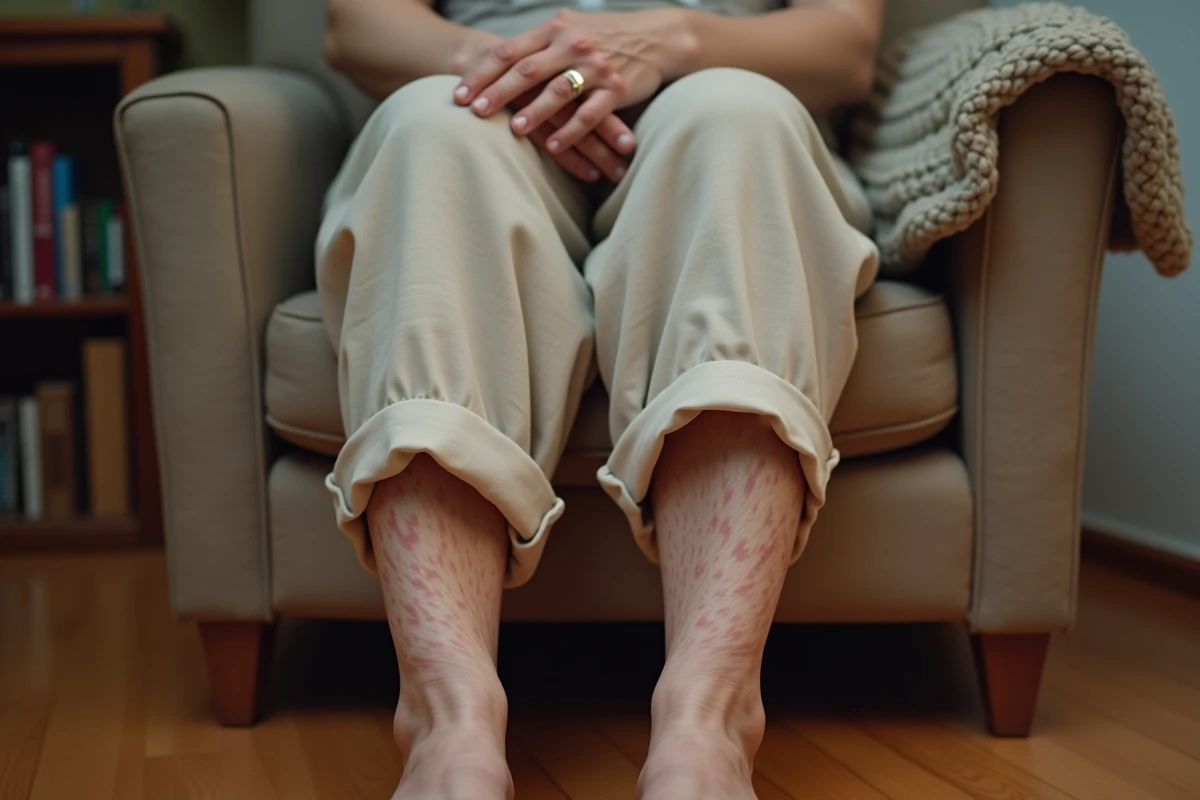
The marbling on the legs of elderly individuals is not merely a sign of skin aging. Behind these purplish or bluish patterns lies a specific vascular phenomenon, livedo, which indicates a slowdown or disruption of subcutaneous microcirculation. In seniors, this phenomenon deserves particular attention: it can remain benign or signal a medical issue that requires management.
Livedo of the legs in seniors: a marker of vascular fragility
Most articles on marbled skin describe the general mechanism (abnormal constriction or dilation of small skin blood vessels) without addressing what this sign specifically represents in older adults. Recent geriatric data provide a different perspective.
An observational study published in Aging Clinical and Experimental Research (Gioia et al., 2023) highlighted that persistent vascular skin abnormalities on the legs often integrate into a phenotype of vascular fragility. This phenotype is associated with decreased walking speed and impaired balance.
In other words, chronic marbling of the lower limbs is not an isolated cosmetic issue: it can accompany sarcopenia, orthostatic hypotension, and an increased risk of falls.
This link between marbling and overall fragility changes the perspective. A persistent livedo in a senior who also experiences dizziness upon standing or a loss of muscle strength should alert the attending physician, even in the absence of skin pain. To better understand the causes of marbled legs in elderly individuals, one must look beyond the skin itself.

Cardiovascular medications and skin marbling: an underestimated avenue
A rarely discussed angle in public content concerns the role of medication treatments. In individuals over 75, polypharmacy is common, and certain drugs directly cause changes in peripheral circulation.
According to a review published in Drugs & Aging (Néel et al., 2022), the appearance of new livedo reticularis should prompt a review of the medication list. Among the implicated treatments are certain beta-blockers, ergot derivatives, and antiplatelet combinations with other vasoconstrictors.
The problem is that these medication-induced marblings closely resemble livedo related to cold or aging. The difference lies in the timeline: if the marbling appeared or worsened after the introduction or change of a treatment, the iatrogenic avenue should be explored first.
Which medications to monitor
- Non-selective beta-blockers, which reduce peripheral blood flow and promote skin vasoconstriction, especially in cool weather
- Ergot derivatives (still prescribed for certain migraines or circulatory disorders), whose vasoconstrictive effect can become excessive in the elderly
- Certain combinations of antiplatelet agents with vasoconstrictive molecules, which disrupt microcirculation in the lower limbs
The reflex should be simple: any new or worsening marbling warrants a review of the prescription with the doctor or pharmacist.
Livedo reticularis or livedo racemosa: a distinction that changes the diagnosis
The two forms of livedo do not convey the same medical message, and this distinction is a crucial clinical landmark.
Livedo reticularis forms regular, closed meshes on the skin, somewhat like a net with a symmetrical pattern. This form is most often benign. It appears in cold conditions, during prolonged standing, or simply with the aging of blood vessels. Generally, warming the skin is sufficient to make the pattern disappear.
Livedo racemosa presents open, irregular, asymmetrical meshes. This form persists even when the skin warms up. It points towards an underlying pathology: autoimmune disease (such as antiphospholipid syndrome), vasculitis, or more rarely, a thrombotic process.
In seniors, the difficulty lies in the fact that both forms can coexist or that skin aging makes visual distinction less clear. A dermatologist can make the call, but a general practitioner also has simple criteria: the persistence of the pattern after warming and its asymmetrical nature are the two most reliable signals to suspect livedo racemosa.

Alert signals associated with marbled legs in the elderly
The marbling itself is not an emergency in most cases. It is the accompanying signs that determine the severity of the situation.
Consult quickly if marbling is accompanied by these symptoms
- Localized pain in the leg, unilateral swelling, or a sensation of warmth, which may indicate deep vein thrombosis
- Associated skin lesions: painful nodules, ulcerations, or areas of skin that have turned dark purplish, possible signs of vasculitis or cholesterol embolism
- Fever or a sudden alteration in general condition, which transforms a simple livedo into a sign of systemic alert
- Marbling that appeared suddenly over the entire body (not just the legs), which may indicate shock or circulatory failure
The context matters as much as the symptom. A stable livedo for years in a healthy senior does not warrant the same approach as a livedo that appeared within a few days in a bedridden or recently hospitalized person.
Marbling and cancer: a rare but documented association
Some patients worry about a link between marbled skin and cancer. The available data do not establish a frequent direct link, but cases of paraneoplastic livedo exist in the medical literature, primarily in the context of hematological cancers or solid tumors causing coagulation disorders. This situation remains uncommon. However, unexplained livedo racemosa, especially if accompanied by weight loss or unusual fatigue, warrants a thorough evaluation.
Marbled legs in seniors often tell a mundane vascular story, related to cold and the aging of small blood vessels. The trap would be to stop at this explanation when other clues (recent appearance, asymmetry of the pattern, associated symptoms, new medication) point to a cause that deserves investigation. A careful look at the prescription and the evolution of the skin pattern remains the best approach.